Online Quran Classes vs Mosque Madrasah UK: How to Choose

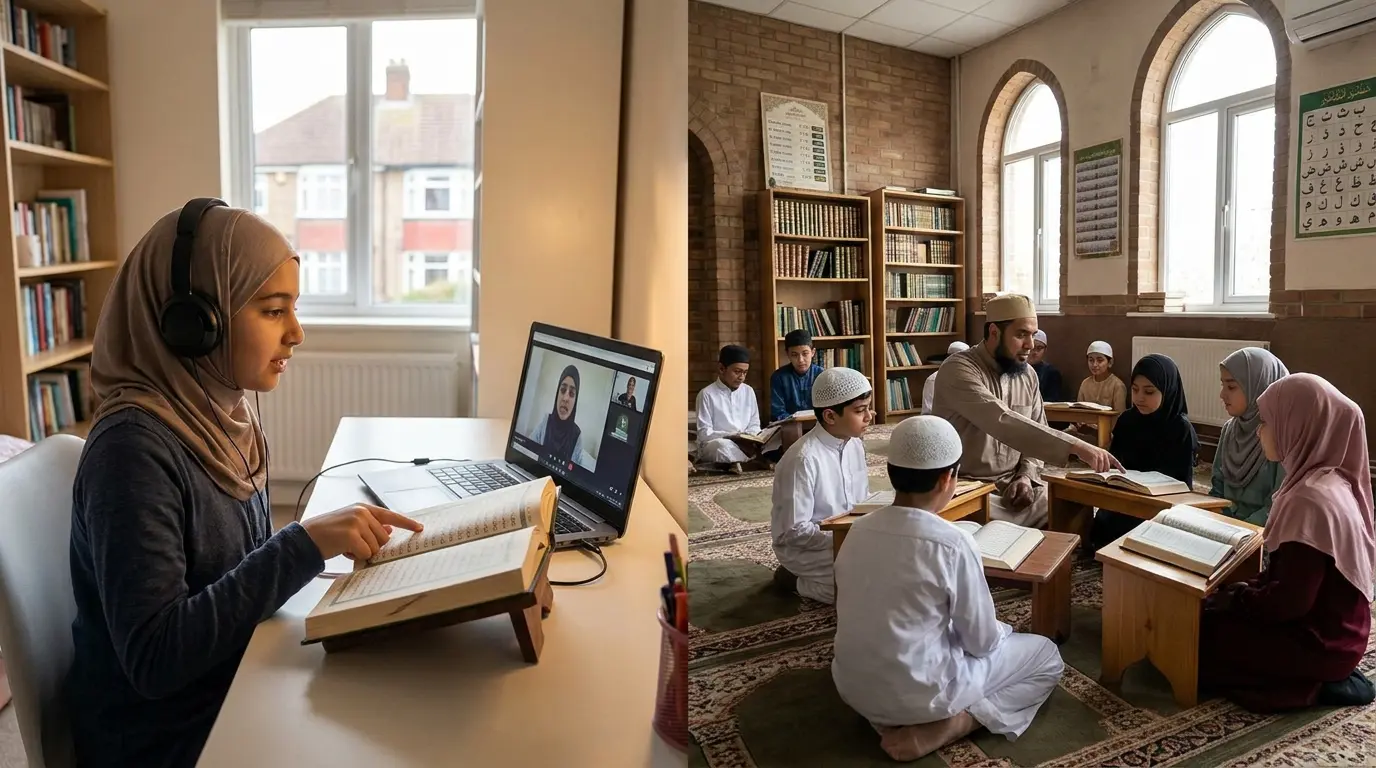
It is 4:30pm, already getting dark, and homework is waiting. Do you drive to the mosque or log in from the kitchen table? Online Quran Classes vs Mosque Madrasah UK: How to Choose is a question many British Muslim parents ask, and neither answer is wrong. This guide compares both fairly so you can decide what suits your child.
What Is a Mosque Madrasah in the UK?
A mosque madrasah in the UK is usually a supplementary school. Children attend a mainstream school during the day, then go to the mosque after school or at the weekend for Islamic education. You may also hear it called a maktab, an evening school or a weekend school, and “madrasah” simply means “school” in Arabic.
A typical mosque madrasah teaches Noorani Qaida, Quran reading, short surahs, duas, salah and basic Islamic manners, usually to children between roughly four and fifteen. Quality and structure vary a great deal. Some run clear curricula with reports and assessments. Others, as guidance written for UK madrasah organisers openly admits, have only a basic curriculum, teach different ages together, and rely on teachers whose main qualification is having graduated from a madrasah or serving as the imam.
None of this is a criticism. Many mosque madrasahs run on volunteers and donations, and they give children something no screen can: a place in the community.
What Are Online Quran Classes?
Online Quran classes are live video lessons where a teacher listens to your child recite, corrects Tajweed and makharij (the points of articulation of Arabic letters) and moves them through a set curriculum: Noorani Qaida, fluent reading, Tajweed, then memorisation (Hifz) if the family wants it.
At Rahiq Academy, lessons are one-to-one, teachers are Al-Azhar qualified and hold an ijazah, and there are specialised curricula for children and adults, with female teachers for women and girls.
One distinction is worth making. Some mosques now run their own “online madrasah”, which is the mosque’s own programme delivered by video. This article is about independent online Quran classes, meaning private lessons from an academy, compared with attending a madrasah in person.
Online Quran Classes vs Mosque Madrasah: Side-by-Side Comparison
Here is how online Quran classes vs mosque madrasah compare on the points parents ask about most. Treat it as a general pattern, because individual mosques and academies differ.
| Factor | Online Quran classes | Mosque madrasah |
|---|---|---|
| Format | Live video, usually one-to-one | In person, usually a group |
| Individual attention | The whole lesson is focused on your child | Shared between the children in the room |
| Teacher background | Ask for ijazah and Al-Azhar credentials | Varies by mosque, from highly trained to volunteers |
| Timetable | Chosen to fit your family, including UK evenings and weekends | Set by the mosque, often after school or at weekends |
| Travel | None | A journey each way, plus parking or the school run |
| Beyond Quran recitation | Depends on the academy’s courses | Often includes duas, salah, manners and Islamic basics |
| Community and friends | Limited | Strong |
| Parent visibility | A parent can sit nearby at home | Usually drop-off, unless you ask to stay |
| Cost | Priced per hour or package | Free, donation-based or a modest fee, varies by mosque |
No column wins every row, which is why online Quran classes vs mosque madrasah is not a question with one right answer. The rest of this guide looks at each difference properly.
A Madrasah Teaches More Than Quran Recitation
This is the point online providers often skip. A madrasah teaches more than Quran recitation. Children also learn how to pray, how to make duas, how to behave in the mosque, and the stories and manners that shape character. They see adults they trust living their faith, and they pray in congregation.
One-to-one online lessons are strongest at recitation, where a teacher needs to hear every letter. If you choose them, check what else the academy offers. Rahiq Academy, for example, also teaches the Arabic language and Islamic studies, including an online Seerah course, so a child can build that wider foundation alongside Tajweed. And whichever route you take, keep the habits a madrasah builds: salah at home, duas before meals and regular visits to the mosque.
Teaching Quality and Individual Attention
Here is some simple arithmetic. If one teacher has a sixty-minute class of twenty children, each child can read aloud for about three minutes. That is an illustration, not a measurement, since good teachers use group recitation and peer listening well. But it shows why attention matters: Tajweed is learned by being heard and corrected, and a mistake with a letter like ض that goes unnoticed can settle into habit and be hard to undo later. In a mixed-age room, a seven-year-old learning Noorani Qaida and a twelve-year-old reciting from the Mushaf also need different things from the same teacher.
In a one-to-one online lesson, thirty minutes can mean thirty minutes of your child’s recitation, with the teacher pausing, modelling the correct makhraj and asking them to repeat. Teacher credentials matter too. An ijazah means a teacher has been authorised to teach the Quran through a chain of transmission, which gives parents something concrete to ask about. Many mosque teachers are sincere, skilled and generous with their time, so ask about class size, curriculum and qualifications rather than assuming either way.
Online has limits as well. A teacher cannot physically adjust a child’s posture or help them hold the Mushaf, so a clear camera and good audio matter.
Cost Per Hour, Not Just Per Month
Mosque fees vary widely across the UK, from donation-based classes to monthly or termly fees, so ask for the actual figure and how many sessions it covers. Then compare the cost per hour and how much of that hour is spent on your child.
Rahiq Academy’s online Quran classes start from £7 per hour, which at the starting rate means a thirty-minute lesson costs £3.50. Check the current pricing for packages. Remember to count travel as well: a twenty-minute drive each way adds forty minutes to every session, plus fuel and parking. A free or low-cost madrasah is hard to beat on price, and many families keep it for that reason. The real question is what each pound and each minute buys for your child.
Safety and Supervision: What to Ask Either Way
Safety and supervision matter in both settings, and UK parents are right to ask about them. Whether it is a mosque or an online academy, ask how teachers are recruited and checked, who supervises lessons, and who you contact if something worries you and how quickly it is dealt with.
At Rahiq Academy, quality monitors sit in on classes from time to time to check the teacher’s level and how teachers treat students, and any inappropriate behaviour is corrected immediately. That monitoring is periodic, not every lesson, so for young children we recommend keeping lessons in a shared room at home with a parent nearby. At a mosque, ask whether you can sit in on a class and watch how the teacher handles the group.
What Online Quran Classes Cannot Replace
Online Quran classes cannot replace the mosque itself. A child who learns only through a screen misses Jumu’ah, Eid prayers, shared iftars and the quiet feeling of belonging that comes from praying beside friends. For children growing up as a religious minority, that matters. Peer motivation is lost too: watching a classmate finish a surah pushes children on in a way a one-to-one lesson does not.
There are practical limits as well. Online lessons need stable internet and a quiet corner, and they add to a child’s screen time. Children under seven usually need a parent nearby for the first few months, with short sessions.
The Hybrid Approach: Mosque for Community, Online for Progress
For many families the best answer is both, and the hybrid approach works because each side covers the other’s gaps. A common pattern is the mosque on Saturday or Sunday for community, Jumu’ah and friends, plus two or three short one-to-one lessons during the week for recitation, Quran Tajweed and memorisation. The mosque does what it does best, while the lessons close gaps in pronunciation. In half-term and school holidays you can add an extra lesson, and our Quran memorisation schedule with a printable tracker can help you plan it.
Questions to Ask Before You Choose
Whatever you pick, these questions to ask before you choose save you from guessing.
At a mosque madrasah:
- How many children are in each class, and are ages mixed?
- Is there a written curriculum, and do parents get progress reports?
- What is the teacher’s background in Tajweed and teaching children?
- What are the term dates, hours and fees?
- Can I sit in on a lesson, and who do I speak to if I have a concern?
With online Quran classes:
- Does the teacher hold an ijazah, and have they taught children my child’s age?
- What curriculum will my child follow, and how will I see progress?
- Are lessons offered at UK times that fit school evenings and weekends?
- Can my daughter have a female teacher?
- What happens if my child does not get on with the teacher?
Rahiq Academy offers two free trial sessions, which helps because one lesson rarely shows how a child will settle. Use the first to meet the teacher and see how your child reacts, and the second to judge whether the corrections and pace work for them.
Which Option Suits Your Child?
Which option suits your child depends on age, where you live, your timetable and what you want them to gain.
A mosque madrasah usually suits you best if:
- There is a well-run mosque near you that you trust
- Your child is young and would benefit from Muslim friends
- The budget is tight
- You want a regular community routine
Online Quran classes usually suit you best if:
- there is no good madrasah within reasonable travel, which is common outside the big cities
- after-school evenings are already stretched
- your child needs more individual attention with Noorani Qaida or Tajweed
- your daughter, or you, would prefer a female teacher
- you are an adult or new Muslim who prefers to learn privately
For children who need extra patience, such as those with autism or ADHD, see our guide to Quran classes for children with autism or ADHD in the UK. To be upfront, our teachers do not have specialist training in additional needs, but they are required to be patient and are briefed on your child’s situation beforehand. If you decide to try online, our guide on how to choose the best online Quran classes for kids explains what to look for, and you can see the online Quran classes for kids course page for details.
FAQs
Are online Quran classes as good as a mosque madrasah?
They are better at some things and weaker at others. One-to-one lessons give more correction and flexibility, which helps recitation and Tajweed. A mosque madrasah gives community, friends and a wider Islamic upbringing. The better choice depends on your child, and many families use both.
Can my child attend a mosque madrasah and take online lessons too?
Yes, and this is common. Keep the mosque for community, salah and weekend learning, and add short one-to-one lessons during the week for recitation or memorisation. Tell both teachers what your child is working on so the lessons support each other rather than repeat the same material.
Is online Quran learning suitable for young children?
Yes, with realistic expectations. Children under about seven usually need a parent nearby at first, short lessons and a teacher who is patient with young learners. If your child cannot sit through the full session, shorten it or try a different time of day.
How many online lessons a week are enough?
Two or three short lessons a week suit many children, with a few minutes of daily practice in between. Consistency matters more than length. Your teacher can adjust the plan after the first few weeks based on how your child is progressing.
How much do online Quran classes cost in the UK?
Prices vary by academy, teacher and number of lessons, so compare the cost per hour rather than monthly headlines. At Rahiq Academy, online Quran classes start from £7 per hour. Ask any provider what is included and whether there is a free trial before you pay.
Can my daughter learn with a female teacher?
Yes. Rahiq Academy has female teachers for women and for girls. Mention it when you book your trial so the right teacher is matched from the start.
What if my child loses focus on a screen?
Start with short sessions, sit nearby and keep the space free of distractions. If focus is still hard after a few lessons, a mosque class or a different time of day may suit them better. The right format is the one your child can actually learn in.
Final Thoughts
Online Quran Classes vs Mosque Madrasah UK: How to Choose comes down to your child, your timetable and what you want them to gain. The mosque gives belonging, friends and a wider Islamic upbringing. Online lessons give focused correction and flexibility around British school life. Many families get the best results by using both, and nothing has to be permanent, because you can try one and adjust.
If you would like to see how one-to-one lessons feel before deciding, browse our courses or book your free evaluation and use the two free trial sessions to see whether it suits your child.
