About This Course
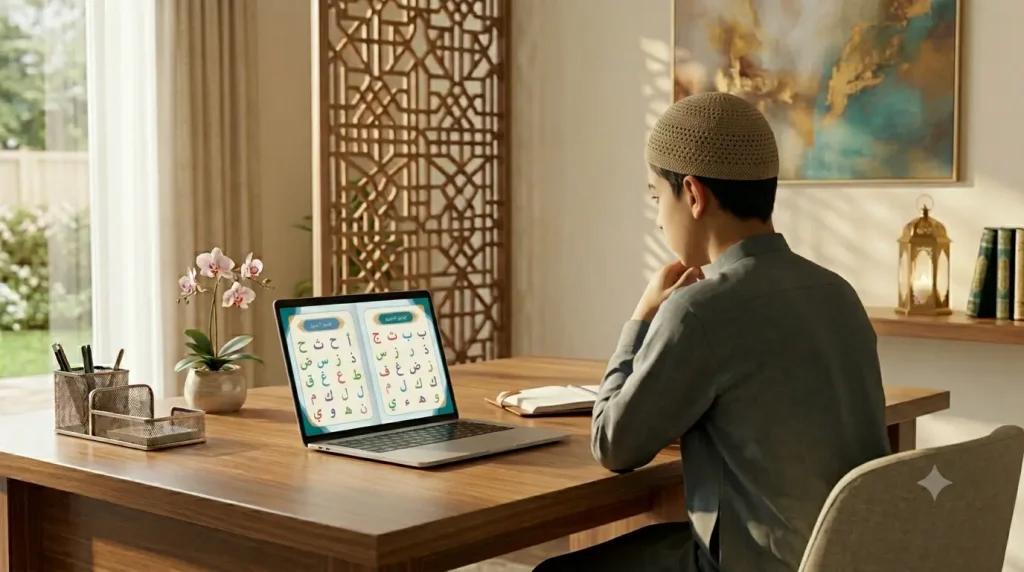
Our Noorani Qaida Online Course takes a complete beginner from not recognizing a single Arabic letter to reading words correctly — through the step-by-step Noorania method that builds sound and shape together, instead of memorizing by rote.
- Step-by-step Noorania method
- 2 free trial lessons
- Male & female teachers available
2. Why This Course
The Qaida is where Quran reading is either set up right or quietly broken for years. Skip it, or rush through it to “start the Quran,” and you spend the next decade fighting letters that sound almost-right — a ع that comes out like a ء, a ث that drifts toward س.
The Noorani Qaida isn’t a children’s booklet to finish quickly; it’s the articulation foundation that decides whether every Surah after it lands correctly. Get the articulation points (makharij) right here, and Tajweed later becomes refinement instead of repair.
- Distinguish and correctly produce the letters beginners most often confuse— ع vs ء, ح vs ه, س vs ث—before they harden into permanent habits.
- Move from isolated letters to joined words to real Quranic words, in that order, so reading rests on the sound rules rather than guesswork.
- Finish able to open a Mus’haf and read—not just recite a memorized Qaida—which is the bridge most courses quietly skip.
Course Content
Duration
4 to 6 weeks
Ages
+5 Best for: absolute beginners of all ages.
- The Arabic alphabet, taught by shape and sound.
- Letter-connection rules: how ب + ا becomes با.
- Short vowels (fatha, kasra, damma), explained in simple words.
- Colorful practice sheets that make daily review fun.
- Pronunciation basics, including throat letters like ع and ح.
- Daily practice habits—kids start asking to review on their own.
Duration
(6 to 8 weeks) For when letters feel familiar.
- Long vowels (Madd), taught using real Quranic words.
- Sukoon and Shaddah for smoother, clearer reading.
- First Tajweed basics like Ikhfa and Ghunnah.
- 50 frequently used Quranic words introduced early for recognition.
- Listening practice with live teacher correction.
- Echo games to strengthen sound memory.
Duration
(8 to 10 weeks) For pre-Hifz or independent readers.
- Full Tajweed rules applied in real verses.
- Short ayahs from the Quran used in every session.
- Stops (Waqf) and starts (Ibtida) practiced in Salah-ready phrases.
- Speed drills to build fluency under time.
- Fixes for confusing letters such as س and ث.
- The transition from Qaida to actual Mus'haf reading.
Most learners begin with a quick placement check during the free trial, so an absolute beginner and a hesitant reader each start at the right point—not both on the same Level 1.
How It Works
- Book two free trial lessons and meet a patient, certified tutor matched to your age and level.
- The tutor checks where you start—letters, joined words, or early reading and sets the right level.
- Choose a weekly schedule that fits school, work, and prayer times.
- Learn live each session, with immediate correction on pronunciation and articulation.
- Practice between sessions with sheets and short tasks, and review progress each week.
Who It's For
- Young children starting out
Children aged 5 and up meeting Arabic for the first time; Noorani Qaida for kids here is taught through play, color, and short sessions, not rote drilling. - Adult beginners & new Muslims
Adults and reverts who never learned to read Arabic; Noorani Qaida for adults moves at a respectful pace, with no childish materials. - Hesitant or self-taught readers
Learners who pieced reading together on their own and still guess at letters; the Qaida fills the gaps silent self-study leaves behind. - Families wanting a real curriculum
For parents tired of random videos, structured Noorani Qaida classes follow one clear path from letters all the way to reading. - Sisters & female students
A qualified female tutor is available on request, in a comfortable and respectful setting, for sisters and girls who prefer it. - Busy adults & professionals
Fitting learning around work, family, and prayer times, with flexible scheduling that keeps you progressing a few weeks at a time.
- Tutors who teach the Qaida properly
Not as a box to tick; every letter's pronunciation is locked in before moving on to the next. - One-on-one correction, live
Your pronunciation is fixed in the moment, the only reliable way to learn sounds you can't yet hear yourself getting wrong. - Female tutors available
For sisters and children who prefer a female teacher, in a comfortable and respectful learning environment. - A real finish line
You end able to read from the Mus'haf, with a placement check so you never repeat what you already know. - Flexible weekly scheduling
Across US, Canada, and Europe time zones, around school, work, and salah.
Frequently Asked Questions
What is the Noorania method, and why start with the Qaida at all?
The Noorania method teaches Arabic reading in a deliberate order — letters, then joining, then vowels and rules — so sounds are built on understanding rather than memorized shapes. Starting here prevents the reading mistakes that are painful to fix later.
Is the Qaida Noorania only for children?
Not at all. The Qaida Noorania works just as well for adults and new Muslims; the materials and pace simply adapt—adults skip the cartoons and move as fast as their accuracy allows.
Do you have female tutors for sisters and girls?
Yes,a qualified female tutor is available on request for sisters and female students, in a comfortable, respectful setting. Just mention it when you book your trial.
I already know some letters—do I have to start from the very beginning?
No. The trial includes a quick placement check, so you start where your reading actually is; partial readers skip ahead rather than repeat the whole alphabet.
How long until I can actually read the Quran?
The three levels run roughly 4–6, 6–8, and 8–10 weeks. Many learners read simple Quranic words by the end of the intermediate level and from the Mus'haf by the end of the course.
Will online lessons really work for learning pronunciation?
Yes,live one-on-one audio is exactly what pronunciation needs. The tutor hears each letter and corrects it on the spot, which a recorded video or app simply can't do.