
What is halal food in Islam? It refers to what’s lawful to eat under Islamic law. It excludes pork, alcohol, blood, and improperly slaughtered meat. But halal isn’t just about meat—it includes how food is prepared, stored, and served. Fish is always halal. Vegetarian food is only halal if free from forbidden additives. So, how can you be sure what’s truly halal today? Understanding the basics can protect your faith and health every day. This guide explains those answers simply and clearly. It gives you what you need to know fast.
What is the meaning of halal?
Halal is an Arabic word that means permissible. In Islam, it describes anything allowed under Shariah, based on the Quran and the teachings of the Prophet Muhammad ﷺ.
What is the definition of Halal Food in Islam?
Definition of Halal Food in Islam is food that Allah permits under Islamic law, based on the Quran and Sunnah. It excludes pork, alcohol, blood, and improperly slaughtered meat. However, halal is not limited to ingredients alone. It also covers how food is prepared, handled, and served. Animals must be lawful, healthy, and slaughtered with Allah’s name mentioned. Blood must drain fully, and cleanliness must remain from source to plate. Fish and seafood are halal by default. Vegetarian food is halal only if free from forbidden additives.
Therefore, halal food protects faith, health, and trust together. It guides daily eating with clarity, balance, and responsibility. By understanding these rules, Muslims can eat with certainty, not doubt.
Prohibited (Haram) Foods in Islam
Islamic law clearly defines prohibited (haram) foods. These rules protect health, faith, and moral discipline. Therefore, Muslims avoid them to ensure they eat with certainty, not doubt.
While halal food stands on clear limits, haram food also has specific boundaries. The Quran and Sunnah explain them simply.
Foods That Are Haram in Islam
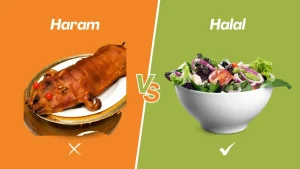
Islam bans specific foods because they harm the body, mind, or ethics. These rules apply to all Muslims, everywhere and at all times.
- Pork and its by-products: Islam forbids pork in all forms. This explicitly includes meat, fat, gelatin, and additives.
- Alcohol and intoxicants: Also, you must avoid any drink or food that intoxicates. This covers wine, beer, spirits, and fermented substances.
- Dead animals (Carrion): You cannot eat animals that die without proper slaughter. This includes roadkill or animals that die naturally.
- Blood: You must fully drain the flowing blood. Thus, consuming blood is strictly prohibited.
- Animals slaughtered without Allah’s name: The slaughterer must mention Allah’s name. If they intentionally skip it, the meat becomes haram.
- Carnivorous animals: Furthermore, avoid animals with fangs (like lions) and birds with talons (like eagles).
- Harmful substances: Finally, Sharia bans anything that harms health, even if the text does not name it directly.
Why Islam Forbids These Foods
Islam protects life and dignity. So, food laws serve clear purposes:
- First, they protect physical health.
- Next, they preserve mental clarity.
- Also, they maintain spiritual discipline.
- Finally, they prevent harm and addiction.
Therefore, these bans always link to protection and balance, never restriction without reason.
Common Sources of Hidden Haram
However, modern food requires extra attention. You must watch for:
- Processed foods with unclear ingredients.
- Flavorings made with alcohol.
- Gelatin from non-halal animals.
- Enzymes from impure sources.
Consequently, reading labels becomes essential for every Muslim.
Quick Reference Table
| Category | Status |
| Pork & Derivatives | Haram |
| Alcohol | Haram |
| Properly Slaughtered Meat | Halal |
| Blood | Haram |
| Intoxicating Substances | Haram |
Islam sets food rules to protect you. Thus, knowing haram foods helps you eat with confidence and faith. For deeper learning, structured study builds certainty.
Quran Verses That Clearly Define Forbidden Foods in Islam
Allah clearly names forbidden foods in the Quran so Muslims eat with certainty, not doubt. These verses form the core legal source for all rulings on haram food.
Surah Al-Baqarah 2:173
He has only forbidden to you carrion, blood, the flesh of swine, and that which has been dedicated to other than Allah.
Surah Al-Ma’idah 5:3
Allah repeats the same ruling to confirm certainty:
Forbidden to you are dead animals, blood, the flesh of swine, and that which has been sacrificed to other than Allah.
Surah Al-An‘am 6:145
Say, I do not find in what has been revealed to me anything forbidden to eat except carrion, flowing blood, the flesh of swine, for it is impure, or that slaughtered in disobedience to Allah.
Together, these verses establish one clear rule about lawful eating. what is halal food in Islam becomes clear through this guidance, as Allah forbids food that harms purity, faith, or moral order. Therefore, Muslims avoid these foods with clarity, obedience, and trust in divine wisdom.
Prophetic Hadith That Clarifies Haram Foods With Absolute Authority
The Prophet Muhammad ﷺ explained forbidden foods clearly so Muslims follow Islam without confusion. These hadith complete the Quranic rulings and guide daily eating with precision.
1. Every Intoxicant Is Haram
The Prophet ﷺ said:
Every intoxicant is khamr, and every khamr is haram
Narrated by Ibn Umar
Sahih Muslim 2003
So any substance that clouds the mind remains forbidden, even in small amounts.
2. Intoxicants Are Forbidden in Any Amount
The Prophet ﷺ said:
Whatever is intoxicating in large amounts, a small amount of it is also forbidden.
Sunan Abi Dawud 3681
3. Predatory Animals Are Forbidden
The Messenger of Allah ﷺ said:
The Messenger of Allah forbade the eating of every beast with fangs and every bird with talons.
4. Allah Forbids What Is Harmful
The Prophet ﷺ said:
Allah is Pure and accepts only what is pure.
Sahih Muslim 1015
5. Forbidden Earnings and Consumption
The Prophet ﷺ said:
Indeed, Allah has forbidden the sale of alcohol, dead animals, swine, and idols.
Narrated by Jabir ibn Abdullah
Sahih al-Bukhari 2236
This hadith confirms that prohibition applies to eating, trading, and benefiting.
The Prophet ﷺ said:
When Allah forbids something, He forbids its price.
Narrated by Abdullah ibn Abbas
Sunan Abi Dawud 3488
Therefore, Islam blocks all paths that normalize haram food.
The Prophet ﷺ said:
Two types of dead animals are lawful, and two types of blood are lawful: fish and locusts, and the liver and spleen.
Narrated by Ibn Umar
Sunan Ibn Majah 3314
This hadith clarifies exceptions with balance and mercy.
Together, these narrations show a clear system. Islam protects health, faith, and conscience by closing every door to harm while keeping lawful ease open.
Scholarly Reliability Note
All hadiths above come from Sahih al-Bukhari, Sahih Muslim, Sunan Abu Dawood, and Ibn Majah, which are accepted primary sources in Islamic jurisprudence. These narrations form the foundation for rulings on haram food, drink, and consumption.
Halal Slaughter Rules (Dhabihah)
Halal Slaughter Rules (Dhabihah) follow clear Islamic rules that protect faith, health, and dignity. These rules guide Muslims on how food becomes lawful, clean, and safe. Therefore, understanding them helps families eat with confidence and a clear conscience every day.
Islam allows food, yet it sets firm conditions. So, permission depends on method, source, and intention together. This balance explains what is halal food in Islam without confusion or excess.
Dhabihah Rules
Dhabihah is the Islamic method that makes meat lawful. It focuses on mercy, cleanliness, and respect for life.
- The animal must be lawful to eat, healthy, and alive at slaughter.
- The slaughterer mentions Allah’s name (Tasmiyah) before cutting.
- A sharp tool cuts the throat, windpipe, and blood vessels quickly.
- Blood drains fully, so harm and impurity leave the body.
- The process avoids cruelty, stress, and unnecessary pain.
Therefore, halal slaughter combines compassion with discipline. It protects the animal while ensuring pure food.
Permissible Foods and Ingredients
Islam permits foods that remain clean, safe, and lawful from source to plate. However, permissibility depends on ingredients and handling, not labels alone.
Permissible Foods and Ingredients
- Lawful meat prepared through valid Dhabihah.
- Fish and seafood that pose no harm.
- Fruits, vegetables, grains, and legumes in their natural form.
- Dairy and oils are free from alcohol or animal enzymes.
- Processed foods with clear, halal-approved ingredients.
Also, honesty in sourcing matters. So, contamination with forbidden items changes the ruling.
Key Difference Between Halal and Non-Halal Food
| Aspect | Halal Food | Non-Halal Food |
| Slaughter | Allah’s name is mentioned | No valid mention |
| Blood | Fully drained | Blood remains |
| Ingredients | Lawful and safe | Includes forbidden items |
| Handling | Clean and careful | Mixed or contaminated |
Why These Rules Matter
These rules protect more than diet. They protect worship, ethics, and trust. Therefore, Muslims follow halal rules to eat with awareness, balance, and obedience. When food aligns with faith, daily life gains clarity and peace.
Summary
What is halal food in Islam defines lawful eating based on faith, method, and intention.
It guides ingredients, preparation, and daily choices. So clarity matters, just as it does with questions like life insurance in Islam, halal or haram. Learning removes confusion and builds confidence. That’s why rahiqacademy.com supports structured learning for anyone seeking a clear, practical understanding.
FAQ’s
Q:What makes food haram in Islam?
A:It contains pork, alcohol, blood, or is not slaughtered Islamically.
Q:Can Muslims eat meat from non-halal sources?
A:No. Meat must be halal-certified and follow Islamic rules.
Q:Is fish halal without slaughter?
A:Yes. Fish is halal and needs no ritual slaughter.
Q:How can Muslims know food is truly halal?
A:By checking ingredients, certification, and avoiding cross-contamination.
Q:Are vegetarian meals always halal?
A:Only if they contain no alcohol or haram additives.
Q:Is gelatin halal or haram?
A:It’s halal only if it’s from Islamically slaughtered animals.
Q:Is all seafood considered halal in Islam?
A:Most scholars permit it, but some avoid shellfish.
Q:Can Muslims consume foods with alcohol traces?
A:No. Any amount of alcohol is not allowed.
Q:Do packaged foods need halal certification?
A:Yes, to confirm no hidden haram content or contamination.
Q:Is kosher food automatically halal?
A:No. Kosher rules differ; halal certification is required.
Q:Can Muslims eat non-halal food in emergencies?
A:Yes. Islam allows exceptions if survival is at risk.
Q:Is McDonald’s food halal?
A:It depends on the country. Some McDonald’s outlets offer halal-certified options.
Q:Why do Muslims eat halal food?
A:Because it follows Allah’s guidance and protects faith, health, and moral discipline.
Q:How is halal food different from haram?
A:Halal is permitted by Islamic law, while haram is clearly forbidden.
Q:Does eating halal affect worship?
A:Yes, lawful food supports spiritual focus and accepted worship.