
What Are Tajweed Symbols in Quran? A Complete Guide to Recitation Marks

When you open the Mushaf (written Quran) for the first time, you’ll notice more than just Arabic letters. The pages are decorated with dots, dashes, small circles, stars, and various markings. What are tajweed symbols in Quran? These aren’t random decorations—they’re a complete system of recitation guidance that has been preserved for over 1,400 years. Tajweed symbols in Quran serve as visual instructions that tell you exactly when to pause, how to pronounce each letter, which rules apply to specific words, and where spiritual moments (like prostration) are encouraged.
What Are Tajweed Symbols in Quran?
Tajweed symbols in Quran are graphical notations and diacritical marks embedded directly into the Mushaf to encode recitation instructions. The word “Tajweed” (تَجْوِيد) means beautification, and tajweed symbols are the tools that help you beautify your recitation by following the exact pronunciation guidelines the Prophet Muhammad (peace be upon him) used.
These symbols do three critical things
- Control vowel sounds through diacritical marks (Harakat)
- Regulate where you pause or continue through waqf (stopping) signs
- Signal pronunciation rules like elongation, nasalization, and emphatic articulation
Without understanding tajweed symbols in Quran, you might accidentally change the meaning of a verse or miss the emotional beauty embedded in the text. Many new readers experience this—they read Arabic letters perfectly but don’t apply the rules that transform correct pronunciation into correct meaning.
Main Categories of Tajweed Symbols
Diacritical Marks (Harakat)
The most fundamental tajweed symbols are diacritical marks, called Harakat (حَرَكَات) in Arabic. These appear as small symbols above or below letters and define which vowel sound each letter carries. The original Quranic text contained only consonants; early scholars added these marks to preserve correct pronunciation for non-Arab Muslims and future generations.
The Three Primary Harakat are:
- Fatha (َ) – A small diagonal line above a letter, produces an “ah” sound (مَ = “ma”)
- Kasra (ِ) – A small diagonal line below a letter, produces an “ee” sound (مِ = “mi”)
- Dhamma (ُ) – A small “و” shape above a letter, produces an “oo” sound (مُ = “mu”)
Additionally, there’s Sukoon (ْ), which appears as a small circle or crescent above a letter and indicates the consonant has no vowel sound following it—the letter is “resting.”
Sukoon deserves special attention because it’s the trigger for multiple major tajweed rules. When Noon (ن) or Meem (م) carries Sukoon, specific rules activate depending entirely on which letter follows. Noon Sakinah triggers Ikhfa, Idgham, Iqlab, or Izhar. Meem Sakinah triggers Ikhfa Shafawi, Idgham Shafawi, or Izhar Shafawi. This is why recognizing Sukoon instantly is foundational to Tajweed mastery.
Shaddah (ّ)
is another critical tajweed symbol that indicates a doubled letter. The first occurrence carries Sukoon, and the second carries the vowel mark shown alongside the Shaddah. Beginners often mispronounce doubled letters because they don’t understand this tajweed symbol. When you see Shaddah over a letter, pronounce it twice without breaking (like “kat-ta-ba” instead of “ka-ta-ba”).
Tanween (Double Vowels)
appears as doubled versions of the short vowel marks, adding an “n” sound to the end of a word. The three types are
- Tanween Fathah (ً) – Produces “an” sound
- Tanween Kasra (ٍ) – Produces “in” sound
- Tanween Dhamma (ٌ) – Produces “un” sound
In Uthmani script, the alignment of Tanween marks provides additional information: parallel marks indicate clear pronunciation (Izhar), while offset marks indicate a nasal sound is required (Ghunnah).
Waqf Symbols (Stopping Signs)
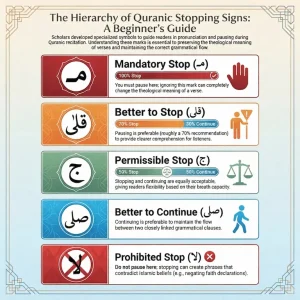
Waqf symbols are among the most important tajweed symbols because they tell you where to pause and how long to pause. There are four main waqf symbols:
- Waqf Lazim (مـ): Mandatory stop. You must stop here; continuing changes the meaning.
- Waqf Jaiz (ج): Permissible stop. You can stop, but stopping isn’t required.
- Waqf Murakhhas (?): Recommended pause. Stopping here is better than continuing.
- Waqf Caution (صلى): Indicates you must not stop; continuing is necessary to preserve meaning.
Each waqf symbol serves a purpose. If you ignore a Waqf Lazim, you’ll blend two separate thoughts into one, confusing the listener and potentially changing the verse’s meaning. This is why tajweed symbols are non-negotiable.
Sajda Symbols
Sajda symbols (۩) appear as dome-shaped marks throughout the Quran and indicate verses where prostration is encouraged or required during recitation. When you reach a Sajda symbol, follow this sequence:
- Complete the verse
- Say “Allahu Akbar” (God is Greatest)
- Perform a single prostration
- Rise and continue recitation
Islamic jurisprudence identifies 14 to 15 Sajda points in the Quran (variation depends on different schools of thought). The Hanafi school counts 14 recitation prostrations, while the Shafi’i, Maliki, and Hanbali schools count 15—a difference tied to how an additional Sajda symbol in Surah Sad is classified. These appear mostly in longer Surahs that discuss the magnificence of creation or divine signs. According to traditional scholarship, you should ideally be in a state of Wudu (ablution) when performing the Sajda, though flexibility exists in certain circumstances. Understanding Sajda symbols is vital for proper worship during Quranic recitation, as they mark moments of spiritual significance and deep reflection.
Advanced Waqf Symbols
Beyond the basic waqf symbols, there are more specialized stopping marks:
- Prohibited Stop (لا): Appears as the Arabic letters “lam” and “alif” (لا), literally meaning “no” or “don’t.” This symbol warns readers NOT to pause at this location. Stopping here can create phrases that contradict Islamic beliefs. For example, stopping at “There is no god” without continuing to “except Allah” negates the entire declaration of faith. If you must breathe here due to physical necessity, keep the pause minimal and restart from at least two words before the stopping point.
- Better to Stop (قلى): Written as “qila” (قلى), this symbol suggests that pausing is preferable, though continuing is also permissible. Think of this as a 70-30 recommendation—stopping is preferred but not mandatory.
- Better to Continue (صلى): Written as “sala” (صلى), this symbol indicates that continuing without pause is preferable, though stopping is allowed. These marks usually appear where two clauses are closely linked grammatically. Continuing maintains the flow and helps listeners grasp the relationship between ideas.
- Saktah (س): The letter “seen” (س) indicates a special type of pause called Saktah, one of the most misunderstood tajweed symbols. A Saktah is a pause in your voice WITHOUT taking a breath. You stop the sound but keep your breath held, then immediately continue. This is different from a normal stop (sound stops + breath taken + resume). Saktah marks appear in specific locations throughout the Quran, often for rhythmic or phonetic clarity.
Verse and Division Markers
Ayah Markers ()
These decorative circles or ornaments appear at the end of each verse. They serve both aesthetic and practical purposes by showing the verse number and division point between verses. Different regions have distinct artistic styles for Ayah markers—some Mushafs feature elaborate floral designs, while others use simple numbered circles. The function remains universal across all authentic editions.
Juz and Hizb Markers (۞)
These symbols divide the Quran into manageable reading portions. The Quran contains 30 Juz (major divisions), 60 Hizb (each Juz has 2 Hizb), and 240 Rub’ al-Hizb (each Hizb has 4 quarters). The Rub’ al-Hizb uses a star-like symbol (۞).
Juz markers typically appear in the margins with ornamental designs. Many Muslims aim to complete the Quran during Ramadan by reading one Juz daily
these markers make it easy to track progress and plan reading schedules. Many readers search for this mark as “the asterisk in the Quran”
that’s the Rub al-Hizb star. In some regional Mushaf styles, the marker appears as an eight-petaled floral rosette instead of a sharp-pointed star; both forms carry the same meaning.
Pronunciation Rule Symbols
Beyond Harakat and waqf signs, there are specialized tajweed symbols that indicate specific pronunciation rules:
- Madd symbols: Indicate vowel elongation (stretching a vowel sound) with varying lengths (short: 2 counts, medium: 4-5 counts, long: 6 counts)
- Iqlab symbols: Indicate sound transformation, particularly Noon Sakinah before Ba
- Ikhfa symbols: Indicate hidden nasalization (Ghunnah)
- Qalqalah symbols :Indicate bouncing consonants that maintain their sound even with Sukoon
Alternative Stopping Scenarios
Mu’anaqah (∴ ∴)
Two sets of three dots create a unique stopping rule: you may stop at either the first set OR the second set, but never both. This symbol appears when two phrases are closely related alternatives or examples. Stopping at both would create unnecessary repetition or break the natural flow. This is considered an advanced tajweed symbol, so beginners should consult qualified teachers when first encountering these marks.
These tajweed symbols are subtler but equally important for mastering proper recitation and understanding the deeper structure of the Quranic text.
Why Understanding Tajweed Symbols Matters
Learning tajweed symbols isn’t about memorizing technical terms. It’s about preserving the Quran’s authenticity and beauty. Here’s why
Meaning Preservation: The Quran is a precise text where a single mispronounced letter can change a word’s meaning entirely. Tajweed symbols prevent this from happening.
Spiritual Connection: Proper recitation (with correct tajweed symbols applied) creates an emotional resonance that lazy reading misses. You’ll hear this difference immediately when comparing a properly recited verse to an improvised one.
Foundational Skill: If you’re working toward memorizing the Quran, understanding tajweed symbols accelerates your progress. Students who learn the symbols first internalize the rules faster and retain memorization longer.
How Non-Native Speakers Benefit Most
If you’re learning Quranic Arabic as a non-native speaker, tajweed symbols are your greatest teacher. They replace the need for constant correction because they encode the rules visually. While native Arabic speakers often absorb Tajweed naturally through immersion, non-native speakers depend on tajweed symbols to guide every recitation session.
In our experience teaching Quran recitation at Rahiq Academy, students who spend even 15 minutes learning what each tajweed symbol means progress 3-4 times faster than students who try to memorize rules without visual reference. This is because tajweed symbols work like a teacher sitting beside you, pointing out exactly where to pause, which letters to emphasize, and how long to hold each vowel sound.
The Path Forward: From Symbols to Fluent Recitation
Understanding tajweed symbols in Quran is the essential first step toward beautiful, accurate recitation. But knowledge alone isn’t enough—you need guided practice with someone who can correct your pronunciation in real-time.
This is where structured learning makes all the difference. When you study tajweed symbols alongside live instruction, a teacher can point out exactly which symbols you’re applying correctly and which ones need adjustment. They can model the proper pronunciation while you watch and listen, then guide you through practice until it becomes automatic.
The good news? Tajweed symbols are learnable. They’re not mysterious or overly complicated. With clear instruction and consistent practice, most students go from confusion to confidence within weeks. Many students describe a breakthrough moment—usually around week 3 or 4—where the symbols suddenly click and recitation becomes natural.
Start learning tajweed symbols today with guided instruction that breaks down each symbol, shows real Quranic examples, and gives you practice with corrective feedback. At Rahiq Academy, we’ve helped thousands of English-speaking students master tajweed symbols and transform their Quranic recitation from hesitant and uncertain to confident and beautiful.
Next Steps
Ready to move beyond surface-level reading and master proper Quranic recitation? Explore our comprehensive Online Quran Recitation Classes where you’ll learn tajweed symbols, master tajweed rules, and develop the fluency that makes Quran recitation a spiritual experience.
Or, if you’re new to structured Quranic learning, book your free evaluation to discuss your current level and create a personalized learning plan.
FAQ
Q: Do I need to memorize all tajweed symbols before I start reading the Quran?
A: No. Start with the basic Harakat (vowel marks) and Waqf symbols, then gradually learn specialized symbols as you progress. Most beginners master the essentials in 2-3 weeks with consistent practice.
Q: What’s the difference between Prohibited Stop (لا) and Better to Continue (صلى)?
A: Both discourage stopping, but for different reasons. Prohibited Stop (لا) means you absolutely must NOT stop because it will distort meaning. Better to Continue (صلى) means you can stop if necessary, but continuing is preferred to preserve flow. Prohibited Stop is non-negotiable; Better to Continue is flexible.
Q: What exactly is Saktah? Isn’t it just a normal pause?
A: No. Saktah (س) is a pause WITHOUT taking a breath—you stop your voice but hold your breath, then resume immediately. A normal Waqf stop means you pause AND take a breath. This distinction is crucial for maintaining proper rhythm and preserving the Quranic melody.
Q: Why do some Qurans have more symbols than others?
A: Different Mushaf editions include different levels of tajweed symbol notation. Some print minimal symbols; others are highly annotated. The standard Hafs ‘an ‘Asim recitation is most common in the US and includes a consistent system of tajweed symbols. Madinah and Indo-Pak editions sometimes use different letters for the same symbol.
Q: Can I recite the Quran correctly without understanding tajweed symbols?
A: Technically yes, but you’ll likely make mistakes. Tajweed symbols exist precisely because humans naturally make pronunciation errors. Using them ensures accuracy without constant correction.
Q: What’s Mu’anaqah and why does it have two stopping points?
A: Mu’anaqah (∴ ∴) marks two phrases that are closely linked alternatives. You may stop at either the first set of dots OR the second set, but never both. This prevents unnecessary repetition while giving readers flexibility based on their breath capacity and the context of their recitation.
Q: Are tajweed symbols the same in every Quran?
A: The core tajweed symbols are standardized, but regional variations exist. For example, Indo-Pak and Madinah editions sometimes use different letters (ص vs ز) for “better to stop.” Learning one system transfers easily to others because the underlying principles are identical.
Q: How long does it take to become fluent with tajweed symbols?
A: Most students become comfortable recognizing and applying tajweed symbols within 4-8 weeks of regular practice (3-4 times per week). Full mastery takes several months, but you’ll see dramatic improvement within the first month, especially after learning the stopping signs.
Q: What’s the difference between tajweed symbols and tajweed rules?
A: Tajweed symbols are visual marks; tajweed rules are the principles they represent. For example, Sukoon is a symbol, while “Noon Sakinah rules” are the specific pronunciation guidelines triggered by Sukoon. The symbol points you to the rule; understanding the rule helps you apply it correctly.
Q: If I learn tajweed symbols, will I automatically know how to apply the rules?
A: The symbols guide you, but applying them correctly requires practice and often instruction from a qualified teacher. Think of tajweed symbols as the map; a teacher helps you navigate it and ensures you’re pronouncing each rule correctly.
Q: What are Tanween marks and how are they different from regular vowels?
A: Tanween (ٌ ٍ ً) appears as doubled versions of the basic vowel marks and adds an “n” sound to the end of a word—producing “an,” “in,” or “un” sounds respectively. Regular vowels (Fathah, Kasra, Dhamma) don’t add this nasal quality. In Uthmani script, parallel Tanween marks indicate clear pronunciation, while offset marks indicate you need to apply Ghunnah (nasalization).
Conclusion
Tajweed symbols in Quran are far more than decorative marks—they’re a complete, sophisticated system of recitation guidance preserved for over 1,400 years. From vowel marks (Harakat) that control pronunciation, to waqf signs that regulate pausing, to Sajda symbols that mark spiritual moments, each tajweed symbol serves a precise purpose in preserving the Quran’s authentic recitation. Understanding what these tajweed symbols mean and how to apply them transforms your Quranic recitation from technically correct reading into deeply meaningful, spiritually resonant worship.
The 15 core tajweed symbols you’ve learned in this guide represent centuries of Islamic scholarship dedicated to protecting the Quran’s integrity and beauty. Each one—from the humble Sukoon that triggers major pronunciation rules, to the Prohibited Stop that prevents theological errors, to the Sajda mark that calls you to sacred reflection—plays an indispensable role in proper recitation.
Whether you’re a complete beginner learning your first vowel marks or someone seeking to master advanced symbols like Mu’anaqah and Saktah, learning tajweed symbols is the investment that multiplies all your other Quranic efforts. Students who understand these symbols progress 3-4 times faster than those trying to memorize rules without visual reference. The path to beautiful Quran recitation starts with understanding these foundational tajweed symbols—so start today, practice consistently, and watch your recitation transform into something that touches hearts and preserves the Prophet’s legacy for future generations.
