
Free Trial Quran Classes in UAE: What to Expect on Your First Online Lesson

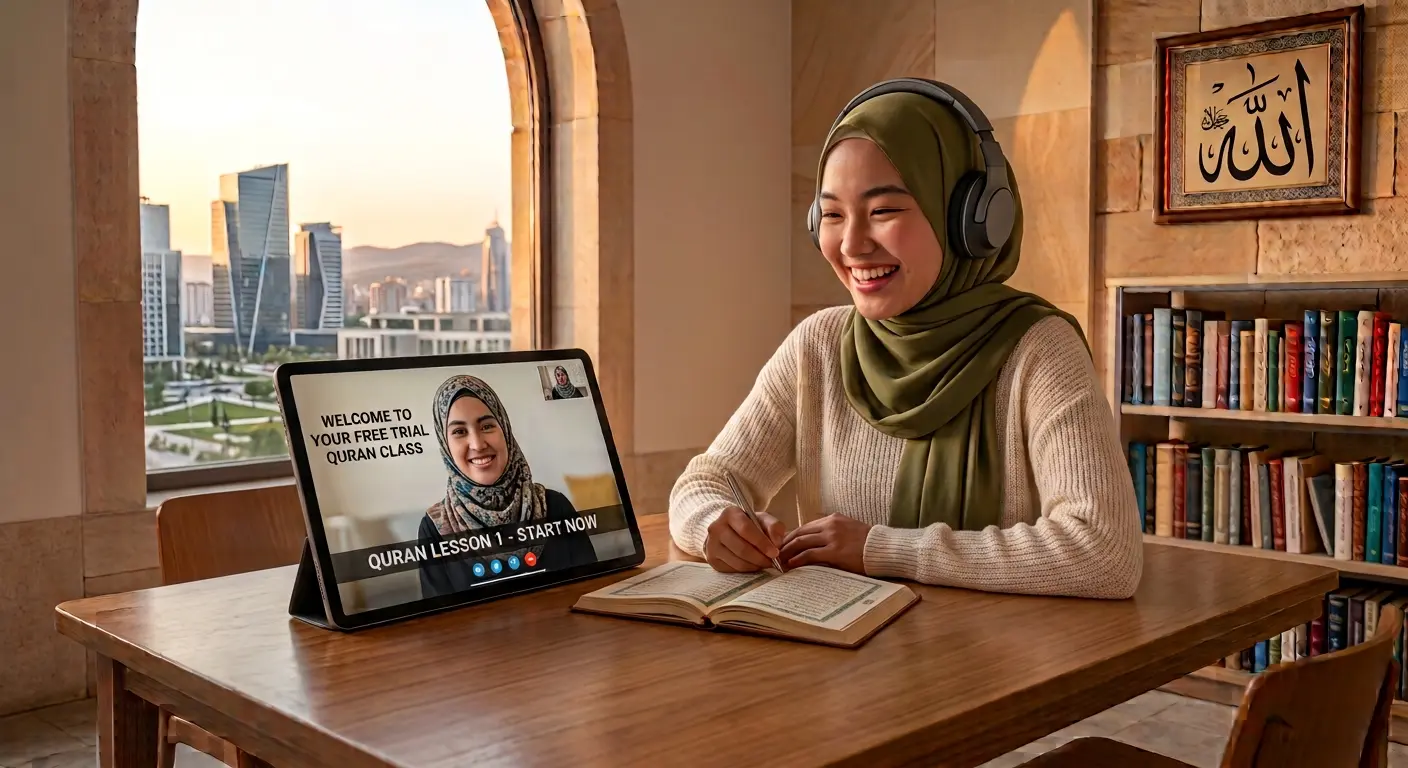
What Actually Happens During a Free Trial Quran Class in UAE (Minute-by-Minute)
The biggest mistake people make before their free trial Quran classes in UAE? They imagine it’s like a formal test. It’s not. Here’s what actually happens:
Minutes 0–5: Technical Check & Comfort
The teacher logs on a few minutes early (most professionals do). You’ll hear them say something like, “Can you hear me okay?” Don’t panic if there’s a slight delay or if the camera takes a moment to focus. Teachers in the UAE do this dozens of times per week—technical glitches don’t bother them.
What they’re actually doing: assessing if your internet is stable enough for regular classes (crucial in UAE where bandwidth can fluctuate), and checking if you’re comfortable on camera. Many teachers will ask a simple question like, “Have you learned any Quran before?” They’re not testing you. They’re gathering information about your level.
Minutes 5–10: Assessment & Listening
The teacher asks you to read something simple. This might be:
- Just the Arabic alphabet if you’ve never seen it
- A short surah (chapter) if you’ve been studying
- The Basmalah (opening phrase) which appears at the start of every surah
What they’re listening for: not perfection. They’re listening for:
- Can you distinguish between similar sounds? (س vs. ص, ذ vs. ز)
- Do you know how to hold letters? (some letters require extending the sound, called madd)
- Are you rushing through words or taking time to articulate?
- What’s your confidence level? (nervous, relaxed, overwhelmed?)
This is the teacher’s real assessment—not of you as a person, but of where to start your learning. If you make mistakes, the teacher expects mistakes. That’s literally why you’re booking a trial, not teaching yourself.
Minutes 10–20: Teaching & Correction
Here’s where free trial quran classes in UAE shows its real value. The teacher will:
- Point out 1–2 specific mistakes (not 10—that’s overwhelming)
- Explain the mistake in simple English (most teachers specialize in non-Arabic speakers)
- Show you how to correct it with a live demonstration
- Have you try it again
Example: “You pronounced this س (seen) like the English ‘s’ in ‘sun.’ In Arabic, it’s sharper—more like the ‘s’ in ‘six.’ Try saying it more forcefully. ” Then they demonstrate. Then you repeat.
What beginners don’t expect: The teacher will often praise what you did right before correcting what’s wrong. It’s not fake—it’s strategic. Your brain learns faster when it’s not in panic mode. A good teacher in a free trial Quran classes in UAE knows this.
Minutes 20–28: Questions & Expectations Setting
The teacher asks: “What are your goals? Do you want to memorize, improve recitation, or understand meaning?” They also explain:
- How often they recommend practice per week (usually 2–3 lessons + daily 10–20 minute practice)
- What to expect after 4 weeks, 8 weeks, 12 weeks
- Whether they think you’re a fit for their teaching style
This is your chance to ask:
- “How do you handle pronunciation correction?”
- “Will you give me homework?”
- “Can I switch teachers if needed?”
- “What’s your cancellation policy?”
A good teacher wants you to know these things. A bad teacher rushes this part or avoids questions.
Minutes 28–30: Wrap-Up & Next Steps
The teacher says something like, “I think we can work well together. Here’s how to book your first real class” or “I want to be honest—I think you’d benefit from starting with Noorani Qaida first. Here’s a teacher I recommend.”
The honest part: Not every teacher is right for every student.
A good free trial Quran classes in UAE reveals this. If the teacher is wrong for you, they should say it. (This rarely happens on trial lessons—teachers are usually welcoming—but it’s worth knowing.)
The Real Fear Behind Booking Free Trial Quran Classes in UAE
Let’s address what’s actually holding you back.
“I’m scared I’ll sound stupid on camera.”
Reality: The teacher will have heard someone mispronounce ع (ain) today. Maybe five times. Your nervousness doesn’t make you unique. What makes you stand out is showing up and trying. That takes courage, and teachers respect that.
“What if my internet cuts out?”
Reality: This happens constantly in the UAE. Teachers have backup plans. Most will reschedule immediately. Having internet hiccups doesn’t disqualify you. (But do test your connection the day before—restart your router, close other apps, etc.)
“I don’t know where to sit or what angle to use for the camera.”
Reality: Honestly, the teacher just needs to see your mouth. Sit at a table facing the camera. That’s it. No special lighting, no perfect background. If they can see you clearly enough to give feedback on mouth position, they’re happy.
“What if I panic and go blank?”
Reality: Silence is fine. Teachers are trained for this. They’ll say, “Take your time—no rush.” A solid 10–15 second pause feels like forever to you but is completely normal to them. You won’t fail by being quiet.
“What if the teacher is judgmental about my English or my background?”
Reality: A teacher offering free trial quran classes in UAE to non-native speakers expects you not to speak Arabic perfectly. If they seem judgmental, that’s your signal to book with someone else. This is precisely why the trial exists—to filter out bad matches.
Prepare for Your Free Trial Quran Classes in UAE (Without Overdoing It)
You don’t need to memorize anything. You don’t need to study all night before. But small prep makes the experience less anxious and more valuable.
Three Days Before:
- Test your internet connection on Zoom or another video app. Do a 5-minute practice call with a friend if possible.
- Find a quiet room in your home where you can have a 30-minute call without people walking in the background. Close your bedroom door if you need to.
- Check if you need to download the platform (Zoom, Skype, Google Meet, or the academy’s custom app). Do this before the scheduled time.
One Day Before:
- Mentally prepare: “The teacher wants to help me. I’m not being tested.”
- If the teacher sent you a link to a specific surah to read, open it and look at it—don’t memorize it, just familiarize yourself so it’s not shocking on camera.
- Get a good night’s sleep. Seriously. Your brain learns better when it’s not exhausted.
30 Minutes Before:
- Use the bathroom (obvious, but many people forget).
- Silence your phone notifications.
- Close browser tabs (they can see your desktop if you screen-share by accident).
- Have a glass of water nearby.
- Start the Zoom/video app early so you’re not rushed.
That’s it. Over-preparation creates anxiety. You’re going to be fine.
How to Know if This Teacher Is Right for Your Learning Journey
After your free trial quran classes in UAE, ask yourself these questions:
Did the teacher explain things in English, or just in Arabic?
- Good answer: “Mostly English with some Arabic terms explained clearly.”
- Bad answer: “They only spoke Arabic; I was lost.”
Did they make you feel rushed, or did they give feedback slowly?
- Good answer: “They went slowly, repeated things, seemed patient.”
- Bad answer: “They moved so fast; I couldn’t keep up.”
Did they acknowledge your mistakes without making you feel stupid?
- Good answer: “They pointed out errors kindly and showed me how to fix them.”
- Bad answer: “They seemed frustrated or dismissive when I made mistakes.”
Did they explain what to expect moving forward?
- Good answer: “They said after 8 weeks of consistent practice, I’d read Surah Al-Fatiha fluently.”
- Bad answer: “No timeline, no explanation of what comes next.”
Did they seem interested in your goals?
- Good answer: “They asked what I wanted to achieve and adjusted their approach.”
- Bad answer: “They just taught the same thing regardless of what I said I wanted.”
If you answered “good” to 4 out of 5, book your first paid class with them. If you got 3 or fewer good answers, try another academy’s trial. This is exactly what the free trial is for.
What Free Trial Quran Classes in UAE Actually Reveal (Beyond What You Learn)
Here’s what teachers are secretly assessing during your trial:
Your motivation level. Do you seem genuinely interested, or are you just curious? (This matters for teacher recommendation, not for judgment.)
Your learning style. Do you learn better with repetition? Visual examples? One-on-one explanations? This helps the teacher prepare materials for your real classes.
Your schedule realism. When you say “I’ll practice 30 minutes daily,” does the teacher believe you? (They can usually tell.)
Your patience with yourself. When you make a mistake, do you laugh it off or beat yourself up? Teachers tailor their feedback style to this.
Your listening skills. Can you follow verbal instructions in English? Can you hear the difference when the teacher demonstrates a sound versus when you try it?
None of these assessments are judgments. They’re data points that help the teacher serve you better in paid classes.
The Truth About What Free Trial Quran Classes in UAE Cannot Deliver
Be realistic about what one 30-minute trial can do:
CAN do: Show you if you like the teacher’s style, assess your starting level, demonstrate what real instruction looks like.
CANNOT do: Teach you pronunciation well enough to practice on your own. You’ll need follow-up lessons for that.
CANNOT do: Fix foundational issues with your mouth position in 30 minutes. That takes 4–6 weeks of consistent practice.
CANNOT do: Give you a complete learning plan. That comes after you’ve had 2–3 paid classes and they understand your goals better.
CANNOT do: Make you fluent or even conversational. Fluency takes 8–12 weeks minimum with structured lessons.
If a teacher promises anything more than this in a free trial, they’re overselling.
FAQ
Q: Will I embarrass myself if my Arabic pronunciation is really bad?
A: No. Teachers working with non-Arabic speakers in the UAE expect imperfect pronunciation—that’s the whole point of lessons. A teacher would be shocked if you pronounced everything perfectly on a trial. Imperfect pronunciation actually shows you’re being honest about where you are.
Q: What if I book a trial and hate the teacher? Can I get a refund?
A: The trial is free, so there’s nothing to refund. Most academies let you book with a different teacher for your first paid class if you don’t click. Rahiq Academy offers teacher switching without penalty—just mention in your booking notes which teacher you’d prefer.
Q: Do I need to know the Arabic alphabet before booking a free trial?
A: No. Most academies will assess your level starting from zero. If you know the alphabet, great—you’ll move faster. If you don’t, the teacher will start with letter sounds. Both are normal.
Q: Can I record the free trial for later review?
A: This depends on the academy’s privacy policy. Always ask the teacher before recording. Most teachers will let you because it helps you remember what they taught, but some prefer to keep sessions private.
Q: What if the free trial is at an inconvenient time? Can I reschedule?
A: Yes. The academy knows you’re testing them—they want you to have the best experience. If the offered times don’t work, ask for a different slot. Most academies in the UAE offer 24/7 availability or at least early morning and evening slots to fit working professionals’ schedules.
Q: After the free trial, how long before I see real improvement?
A: After 4 weeks of 2–3 lessons per week + daily practice, you’ll hear and feel noticeable improvement in pronunciation. After 8 weeks, you’ll read simple surahs with confidence. After 12 weeks, you’ll sound like an actual Quran student, not a beginner.
After Your Free Trial: Making the Next Decision
The free trial Quran classes in UAE serves one purpose: helping you decide if structured learning with this teacher is worth your time and money. That’s it. You’re not locked in. You’re not obligated. It’s a 30-minute conversation between you and a teacher.
If you felt respected, understood, and hopeful during those 30 minutes, that’s your signal to book. If you felt rushed, confused, or judged, that’s your signal to try another academy.
Your learning journey matters. Your choice of teacher matters. The free trial exists specifically to help you make that choice confidently.
Ready to Start? Book Your Free Trial With Confidence
Stop overthinking this. Anxiety before trying something new is normal. But it’s not a reason to delay. The teacher offering a free trial Quran classes in UAE has done this thousands of times. You’re not their first nervous beginner. You won’t be their last.
Book your free trial with Rahiq Academy today and experience the difference structured instruction makes. Choose a teacher who specializes in non-Arabic speakers, ask the questions that matter to you, and see if this is the right match for your Quranic journey.
Or explore our different course options to understand what happens after your free trial, so you go in knowing exactly what to expect next.
The best time to start was yesterday. The second-best time is now.
