
Online Quran Classes for Kids in UAE: Safety & Results

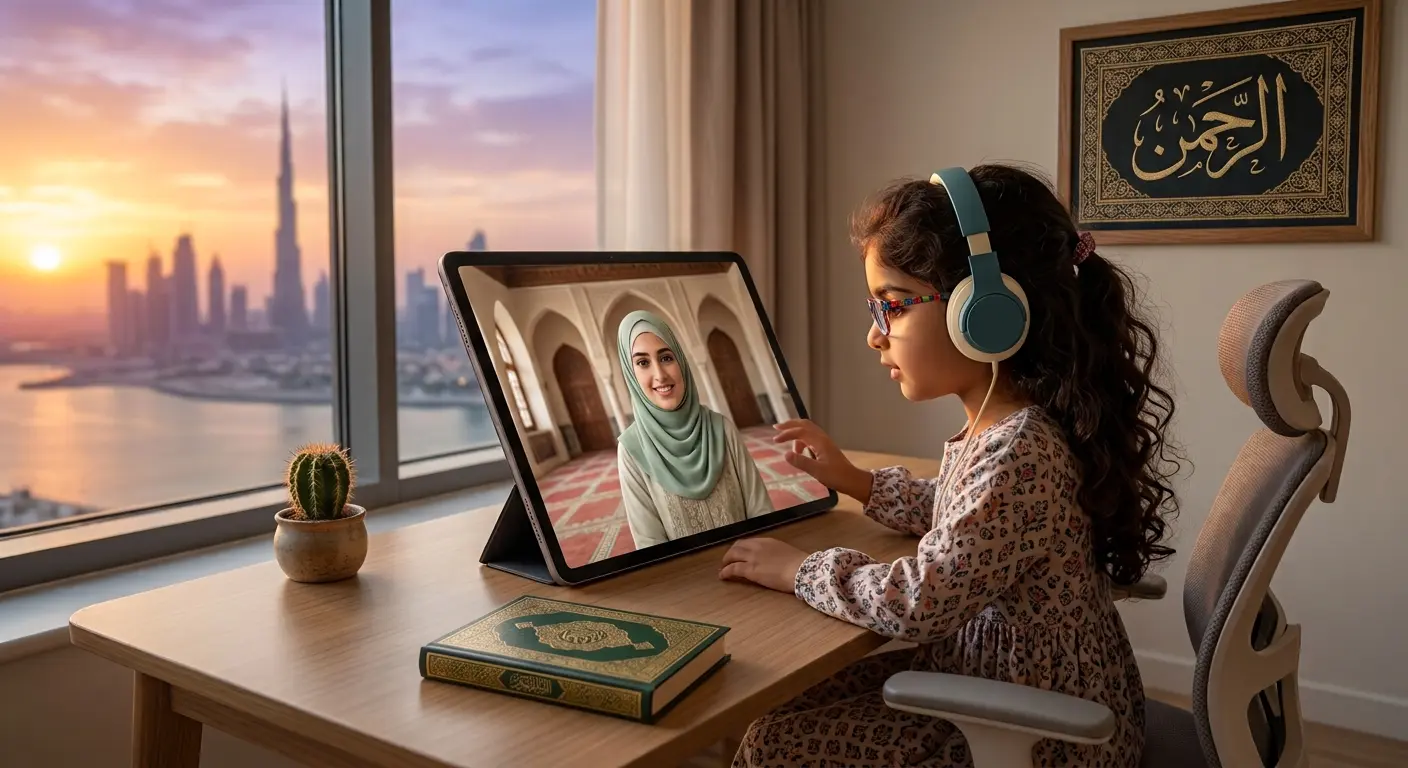
When you enroll your child in online Quran classes for kids in UAE, two questions drive every parent’s decision: Is it truly safe? and Will it actually work? These aren’t small concerns—they’re foundational. The good news: when you choose the right platform with proper safety protocols and evidence-based teaching methods, online Quran classes for kids deliver both. Your child learns from home with certified teachers, detailed progress tracking through post-lesson reports, and consistent administrative oversight. Security and results aren’t competing goals; they’re the foundation of quality Quranic education.
The Parent’s Real Concern: Safety in Online Quran Classes for Kids in UAE
Parents worry for good reason. Online learning means your child interacts with adults over video—a reality that demands absolute transparency and rigorous safeguards. The difference between platforms isn’t subtle; it’s the gap between casual supervision and fortress-level protection.
When you select online Quran classes for kids in UAE, real safety means far more than saying “we have background checks.” It means understanding exactly what you’re protected against and how the academy prevents each risk.
What “Safety” Actually Means (And What It Doesn’t)
Many academies throw around vague terms: “certified teachers,” “safe environment,” “parental monitoring.” These sound reassuring but lack specifics. Real safety is granular, documented, and auditable. When your child joins quality online Quran classes for kids in UAE, here’s what legitimate safety looks like:
Verified teacher credentials
Not just an Ijazah or Islamic certificate, but criminal background clearance (police verification), references from previous employers, and documented teaching experience. A qualified teacher has provable history, not just claims. Academies should voluntarily share verification summaries with parents.
Encrypted, password-protected lessons
Each class happens in a secure portal where only your child, the teacher, and you (parent) have access. No random students can join. No public links. No social media integration. Zoom, Google Meet, or custom platforms—all must have privacy-level security equivalent to banking apps.
Quality assurance monitoring on every session
Every lesson is monitored by administration to ensure consistent teaching standards, proper methodology, and appropriate student engagement. This internal monitoring (separate from teacher-student interaction) guarantees that your child receives consistent, quality instruction across all sessions.
Post-lesson progress reports
After each session, you receive specific details about what was covered, what your child accomplished, and what needs practice at home. This creates a documented trail of progress and ensures you stay informed without surveillance.
Third-party safety audits
Leading academies submit to independent security audits (not self-audits). This verifies that encryption works, data isn’t leaked, and systems actually prevent unauthorized access. Ask prospective academies if they’re willing to share audit reports.
What Sets Rahiq Academy Apart: Safety as Non-Negotiable
At Rahiq Academy, safety for online Quran classes for kids in UAE isn’t a feature—it’s the foundation. Every teacher completes:
• Professional teaching evaluation (observed lessons, student feedback, methodology review)
• Mandatory safeguarding training (recognizing vulnerable moments, appropriate boundaries, reporting procedures)
• Ongoing compliance checks (quarterly re-verification, renewed background checks every 2 years)
• Child psychology certification (understanding child development stages, attention spans, emotional safety)
Administration monitors every lesson to ensure consistent quality and adherence to teaching standards. Parents receive detailed post-lesson reports after each session and can communicate with administration anytime about student progress, observations, or concerns. This creates transparent, ongoing dialogue about your child’s learning journey.
Measurable Results: What Actually Happens in 4-8 Weeks
“Results” means different things to different parents. Some want Quranic fluency. Others seek confidence-building. The best online Quran classes for kids in UAE deliver specific, trackable progress in all dimensions.
Week 1-2: Foundation & Confidence Building
In the first two weeks, your child is adjusting to online learning format. Real results here aren’t recitation breakthroughs; they’re psychological:
• Comfort with the teacher (does your child look forward to lessons, or dread them?)
• Understanding of the learning structure (can they sit for 30-40 minutes without constant distraction?)
• Confidence that mistakes are safe (do they attempt pronunciation boldly, or stay silent from fear?)
Measurable checkpoint: By week 2, your child should initiate conversation with their teacher without prompting, attempt new sounds even if uncertain, and complete basic practice without parental pressure. If this isn’t happening, the teacher-child fit may need adjustment—a sign that the right platform will address quickly.
Week 3-4: Phonetic Mastery & Early Application
By week 3-4, physical progress becomes visible. Your child’s mouth is conditioning to Arabic letter articulation points (Makharij). Specific benchmarks:
• Clear pronunciation of 15-20 core Arabic letters (ا, ب, ت, ث, ج… through ي)
• Distinguishing between similar-sounding letters that trap English speakers (ح vs خ, س vs ص)
• Joining letters into simple words without stumbling
• Reproducible correct pronunciation (they don’t just nail it once; consistency is building)
Measurable checkpoint: Record your child reading 5 simple Arabic words. Compare week 1 recordings to week 4. Improvement should be audible—not perfect, but noticeably clearer, more confident, with fewer false starts.
Week 5-8: Tajweed Rules & Full Surah Recitation
By week 5-8, your child is applying foundational Tajweed rules to actual Quranic verses. Progress becomes unmistakable:
• Correct application of Izhar (clear pronunciation in required contexts)
• Recognizing when letters should be merged (Idgham) and doing so correctly
• Reading full short Surahs (Surah Al-Ikhlas, Al-Falaq, Al-Nas) with audible Tajweed application
• Improved breath control and natural pausing at punctuation
• Spontaneous correction of their own mistakes (they catch errors without teacher prompting)
Measurable checkpoint: By week 8, your child should recite a complete short Surah smoothly. Have a qualified listener (the teacher, a parent who knows Quranic recitation, or a family member with Islamic education) evaluate whether rules are being applied correctly. Clear improvement in this 8-week window is the gold standard for online Quran classes for kids effectiveness.
Results Beyond the Classroom
Real results extend past recitation technique. Parents report:
• Spiritual engagement: Children ask about Surah meanings and want to understand what they’re reciting
• Behavioral shifts: Kids mention Quranic verses or lessons naturally in daily conversation
• Confidence spikes: Reciting in front of family becomes something they volunteer to do, not resist
• Discipline strengthening — Regular practice habits transfer to other areas (homework consistency, practice routines)
• Family connection: Parents report deeper conversations about faith and Islamic values
These aren’t measurable in metrics, but they’re real outcomes that distinguish quality online Quran classes for kids from hollow experiences.
Why Online Quran Classes for Kids in UAE Work Better Than Parents Expect
The skepticism is understandable: Can a child really focus on recitation through a screen? The answer, backed by recent educational research, is surprisingly affirmative—under specific conditions.
The Science: How Kids Learn Language Online
Studies from MIT’s Media Lab and Stanford’s Graduate School of Education found that one-on-one online instruction for language skills produces equivalent or superior outcomes compared to in-person classes. Why?
Reduced social anxiety
A child focusing on Tajweed through a screen faces less social pressure than standing in front of peers or relatives at a mosque. Mistakes feel private, less humiliating, more correctable. This psychological safety translates directly into bolder practice.
Complete teacher focus
In-person group classes divide the teacher’s attention across 5-15 students. Online one-on-one instruction means 100% focus on your child’s pronunciation, pace, and emotional state. Teachers catch subtle pronunciation errors that would vanish in group noise.
Repetition and personalized feedback
Children learning to recite benefit from targeted, repeated feedback. Online one-on-one teachers can work with your child on specific problematic sounds multiple times in a single session, something impractical in group settings. Teachers adapt practice based on your child’s pace and learning style.
Customized pacing
Your child’s learning speed is unique. Some need 10 repetitions; others need 3. Online classes scale exactly to your child’s needs without forcing them to match group pace. This reduces frustration and maximizes retention.
Home environment stability
Kids learn best in familiar, comfortable spaces. Online classes happen in their home, eliminating travel stress, unfamiliar classrooms, and environmental overwhelm.
How to Ensure Results: What to Look for in Online Quran Classes for Kids
When evaluating what to look for in online Quran classes for kids, not all platforms delivering results share the same methodology. Parents choosing the right program should systematically evaluate several critical factors. Here’s exactly what matters:
Teacher Specialization in Child Education
Teaching children Quran differs fundamentally from teaching adults. A qualified adult teacher isn’t automatically qualified for kids. Look for:
• Documented experience teaching children (minimum 3+ years, verifiable)
• Child development training (understanding ages 4-6 attention spans, ages 7-10 learning styles, teenage psychology)
• Pedagogical methodology for Quranic instruction (structured progression, not ad-hoc lessons)
• Demonstrated ability to redirect behavior (when a child loses focus, how does the teacher re-engage without frustration?)
• Positive reviews specifically from parents with kids in the target age range
Curriculum Structure That Guarantees Progress
Effective online Quran classes for kids follow a research-backed sequence, not randomized lessons. Look for:
Foundational clarity
Does the academy start with Noorani Qaida (Arabic alphabet mastery) before jumping to Tajweed rules? Skipping this stage guarantees later confusion.
Measurable benchmarks
Can the academy articulate exactly what your child will master by week 4, week 8, week 12? If answers are vague (“we’ll help them improve”), the curriculum likely is too.
Spiral review
Quality programs revisit earlier concepts constantly, strengthening retention. If lessons only move forward without reinforcement, progress plateaus.
Pacing flexibility
While structure matters, the best online Quran classes for kids adjust pace when a child needs extra time. Rigid, speed-focused curricula ignore individual needs.
Progress Tracking That Goes Beyond Vague Praise
Every parent wants to know: Is my child actually progressing? Legitimate platforms provide:
Post-lesson progress reports
Specific accomplishments after each session (e.g., “Successfully mastered emphatic letters ص, ض, ط, ظ pronunciation”), what was covered, and targeted home practice recommendations.
24/7 open communication with administration
You can reach out anytime with questions, observations, or concerns about your child’s progress. Responses are prompt and detailed, not generic.
Quality assurance monitoring on every lesson
The academy doesn’t just rely on teacher-student interaction. Every lesson is monitored by administration to ensure consistent teaching quality, proper methodology application, and appropriate student engagement across all of your child’s sessions.
Active discussion of student observations
When you notice something (progress, struggle, behavioral pattern, learning preference), the teacher and admin actively discuss these observations with you. This creates a collaborative approach to addressing your child’s specific needs.
Transparent communication about struggle
When a child hits a plateau or regresses, quality academies proactively communicate this, explaining what’s happening and adjusting the approach accordingly—rather than pretending everything is fine.
Safety & Results: Addressing Your Biggest Concerns
“My child has never done online learning before. Will they adjust?”
Most children adjust faster than parents expect. Online lessons feel like one-on-one time with an adult they like—not so different from a private tutoring session. The first lesson is often novel and exciting. Weeks 2-3 can feel mundane (the novelty wears off), but by week 4, structured routine becomes the child’s comfort zone.
Practical tip: Treat the first month as an adjustment phase, not an assessment of permanent fit. If by week 4 your child resists consistently (won’t join calls, cries beforehand), the teacher-child fit may genuinely be mismatched. Quality platforms offer teacher changes without penalty.
“How do I know the teacher isn’t doing anything inappropriate?”
This is the right question to ask. Here’s what absolute assurance looks like:
•Administration monitors every session. Teachers know their work is audited; accountability shapes conduct.
•You receive summaries of every lesson. What was taught? What did your child learn? This creates a documented trail. Concerning behavior surfaces immediately.
•Your child has agency. Quality platforms train kids to voice discomfort: “If anything feels wrong, tell your parents immediately.” Children given permission to speak up will.
•Background verification is rigorous. This isn’t foolproof, but it eliminates the most obvious risks. Academies should volunteer this information, not hide behind privacy claims.
“My child learns differently. Will they be accommodated?”
Competent online Quran classes for kids assess your child’s learning style in the first or second lesson. Does your child learn better through repetition? Visual aids? Stories and examples? Movement breaks?
Quality teachers adjust immediately. The child who needs 10 breaks in 40 minutes gets breaks. The child who thrives with laser focus gets minimal interruption. This customization is easier online than in traditional classrooms.
Red flag: If the teacher says “we follow the same curriculum for everyone and your child will adjust,” seek alternatives. Learning differences are real; quality teaching accommodates them.
“What if my child gets frustrated or quits?”
Frustration is normal. Learning requires productive struggle—not paralysis, but challenge that stretches ability. Quality teachers distinguish:
• Productive frustration: “I’m trying something hard and I’m getting closer.”
• Destructive frustration: “This is impossible, and I’m failing.”
Teachers manage this through encouragement, breaking tasks into smaller pieces, celebrating small wins, and knowing when to pull back. If your child is consistently frustrated (crying, resistant to lessons), the pace needs adjustment. Any academy that says “just push through” is wrong.
Quitting is sometimes legitimate feedback—maybe the teacher-child fit is poor, or your child’s developmental readiness isn’t there yet. Quality platforms address this without guilt-tripping: “Let’s try again in 6 months” is a valid path.
UAE-Specific Realities: Schedule, Culture, & Education Context
Parents in Dubai, Abu Dhabi, Sharjah, and across the Emirates face specific pressures that online Quran classes must accommodate.
School Pressure & Extracurricular Overload
Most UAE kids attend demanding international schools (IB, IGCSE, American curriculum) with heavy homework loads, multiple extracurriculars, and intense academic competition. Adding Quran classes can feel impossible.
Realistic expectation: Quality online Quran classes for kids respect this. Sessions should be 30-40 minutes (not dragging into an hour when energy is spent). Scheduling should offer options outside prime homework time (early morning before school, evening after 7 PM, weekends).
Academies that demand rigid 5-days-per-week commitment or 60-minute sessions are misaligned with UAE family reality. Flexibility isn’t a luxury; it’s essential.
Diverse Family Backgrounds
Many UAE families have mixed Arabic/non-Arabic backgrounds. Some parents speak Arabic at home; others are entirely English-speaking. Some have Islamic education; many don’t.
Implication: Your child may be the only family member confident discussing Quranic concepts. This isn’t wrong, but it means parents can’t verify learning through home conversation alone. Detailed post-lesson reports become essential so you understand what was covered and how to support at home. Teachers should explicitly translate Islamic concepts for non-Arabic speaking parents.
Cultural Sensitivity Without Cultural Watering-Down
UAE families are proudly Muslim in a cosmopolitan environment. You likely want your child’s Islamic education to be authentic—not simplified, but also not overwhelming. Online Quran classes should balance:
• Authenticity: Real Islamic teaching, proper Tajweed, understanding Quranic meaning—not diluted versions
• Accessibility: Teaching in English, explaining concepts clearly, not assuming Islamic background
• Age-appropriateness: Complex Islamic concepts introduced gradually, not pushed prematurely
Red Flags: How to Identify Online Quran Classes That Won’t Deliver
Before enrolling, knowing how to identify online Quran classes that won’t deliver is critical. Watch for these warning signs that indicate an academy may not meet your child’s needs:
•No background check transparency
if asked about teacher verification, the academy deflects or says “of course we do it, but we can’t share details,” walk away. Legitimate institutions volunteer this information proudly.
•Vague progress communication
Responses like “your child is doing great” without specifics (which letters mastered, what Tajweed rules applied, what needs practice) suggest the teacher isn’t tracking actual progress. Quality academies provide detailed post-lesson reports and encourage direct communication about student observations and concerns.
•Pressure for long-term contracts with no trial
Quality platforms offer free trials so you can assess fit. Demanding commitment before you’ve seen the teaching is a red flag.
•Aggressive upselling
If the initial pitch is about premium packages and pricing tiers rather than teaching philosophy and safety, reconsider.
•Unwillingness to change teachers
If a teacher-child fit is poor and the academy insists you “just need to give it more time,” this is unacceptable. Competent platforms change teachers without penalty.
•Unclear communication channels
If it’s unclear how you’ll stay informed or reach administration with questions about your child’s progress, the communication system is weak. Quality academies clearly explain their post-lesson reporting process and how/when parents can discuss student needs.
FAQ
Q: At what age should my child start online Quran classes?
A: Ages 4-5 are ideal if your child can sit still and follow basic instructions. Readiness depends on the individual—some excel at 3, others at 6. A free trial lesson clarifies whether your child is ready. Early start (4-6) maximizes language learning advantages without creating pressure.
Q: How much home practice is needed?
A: 15-20 minutes daily is ideal (listening to recordings, attempting recitation, reviewing notes). More risks burnout; less stalls progress. Teachers should provide specific, clear practice guidelines—not vague instructions.
Q: Should I watch every lesson?
A: For ages under 10, parental presence (available to observe if you choose) can be helpful. Ages 10+, they attend alone. Stay informed through the post-lesson progress reports provided after each session and through direct communication with administration if questions arise. This keeps you connected without hovering.
Q: What if my child speaks no Arabic?
A: This is ideal for online learning. Start with Noorani Qaida (Arabic alphabet foundation—usually 6-8 weeks), then move to Quran reading. Non-native learners often progress faster than native speakers. Teachers experienced with non-native students handle pronunciation challenges clearly.
Q: How long to memorize a full Surah?
A: Short Surahs (Al-Ikhlas: 4 verses) take 2-4 weeks with daily practice. Longer Surahs take months. Prioritize accuracy over speed. Quality programs emphasize depth, not quantity.
Q: Will online learning worsen my child’s frustration?
A: Often the opposite—no peer competition or public performance reduces frustration. One-on-one attention lets teachers catch frustration early and adjust pacing. Mention learning sensitivities upfront; quality teachers have strategies for managing challenge.
Q: Can we take breaks (summer, travels)?
A: Yes. Quality platforms accommodate breaks without penalties. Your child resumes where they left off with a light review. Most re-acclimate within one lesson. Flexibility is essential.
Q: Is online learning as effective as mosque classes?
A: For recitation skill, one-on-one online instruction is often more effective than group mosque classes. Your child gets individualized attention, personalized pacing, detailed feedback in post-lesson reports, and no peer distraction. Mosque classes offer community value; ideally combine both for skill development and community connection.
Conclusion
Online Quran classes for kids in UAE can deliver both safety and results when you choose the right platform. Safety isn’t theoretical—it’s granular, auditable, and built into every system (verified teachers, encrypted sessions, administrative monitoring, transparent communication). Results aren’t aspirational—they’re trackable in 4-8 weeks through measurable benchmarks in pronunciation, Tajweed application, and confidence.
When you enroll your child in online Quran classes for kids with Rahiq Academy, you’re investing in authentic Quranic education delivered by certified teachers with specialized child education training, protected by rigorous background verification and administrative quality assurance, and supported by detailed progress tracking and open communication that keeps you informed every step of the way.
Your concerns about safety and results are valid. They deserve more than reassuring words. They deserve systems, verification, and transparency. The right online Quran classes for kids provide exactly that—along with the spiritual and intellectual growth your child deserves.
Ready to see the difference real safety and measurable results make? Book your child’s free trial evaluation today with Rahiq Academy. Experience firsthand how our approach combines rigorous protection with proven progress.
