GCSE Arabic vs Quranic Arabic: What’s the Difference?

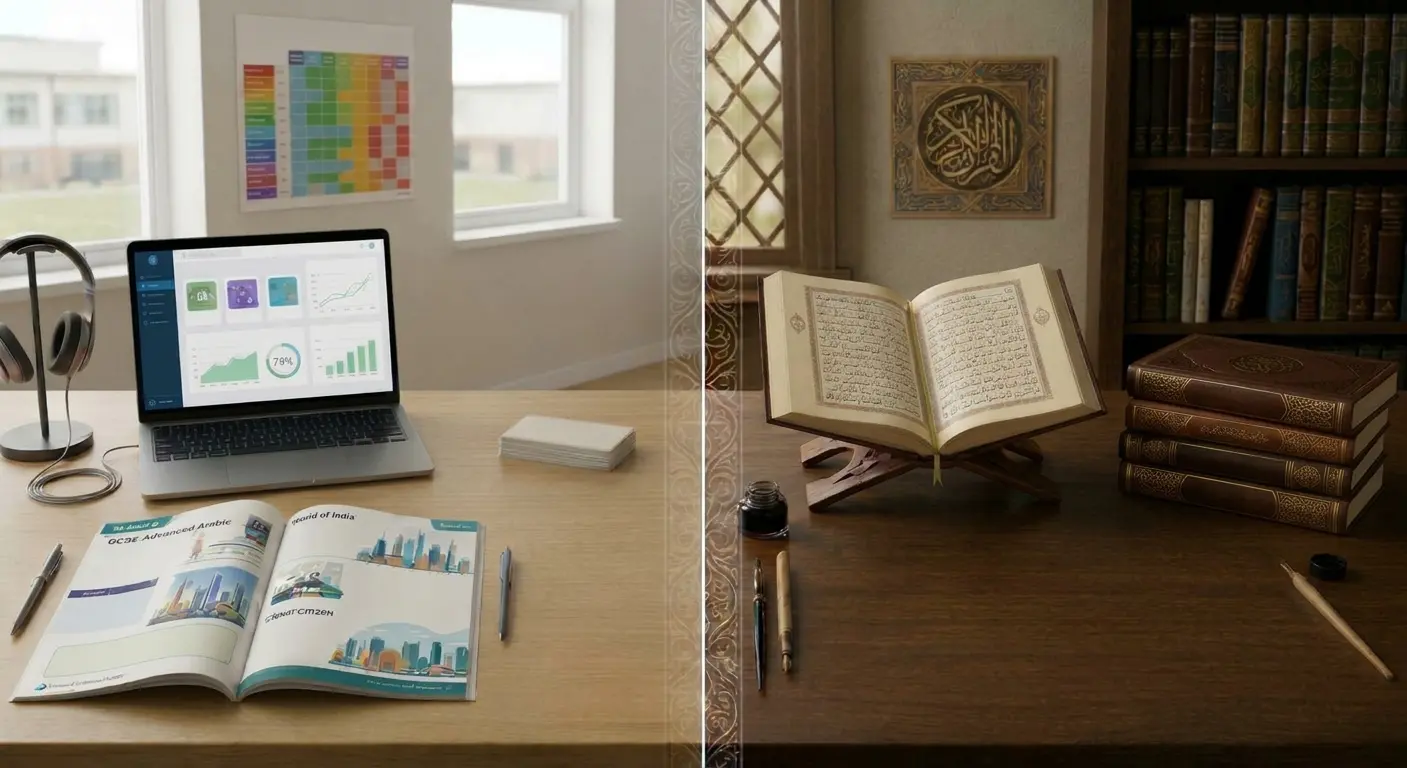
If your child is choosing school options, you may be asking one question: GCSE Arabic vs Quranic Arabic: What’s the Difference? They share the same script and a common grammatical foundation, but they serve different goals. One prepares students for a UK exam in Modern Standard Arabic. The other opens the language of the Quran. Here is how they differ and how to choose.
What Is GCSE Arabic?
So, what is GCSE Arabic? GCSE stands for General Certificate of Secondary Education, the qualification most students in England take around age 16. GCSE Arabic is one of the modern foreign languages offered, with Pearson Edexcel as an awarding body for the qualification.
The course teaches Modern Standard Arabic (Fusha), the formal Arabic used in news, education, and writing across the Arabic-speaking world. Students are assessed on listening, speaking, reading, and writing, usually through everyday themes such as travel, education, and the environment. The aim is practical communication, not religious study.
What Is Quranic Arabic?
Quranic Arabic is the Classical Arabic of the Quran, a language of 7th-century Arabia. People learn it to understand the Quran directly rather than relying only on translation, and often alongside Tajweed and recitation.
Learning Quranic Arabic means focusing on the words and structures that appear in the Quran. That includes root words (the three-letter patterns behind most Arabic vocabulary), classical grammar (nahw), and word formation (sarf). Students rarely practise ordering food or writing a letter. They practise recognising meaning, patterns, and context inside the text.
GCSE Arabic vs Quranic Arabic: Key Differences
Here are the key differences between GCSE Arabic and Quranic Arabic, and they come down to purpose, language, and skills.
Purpose
GCSE Arabic is an exam course. Quranic Arabic is a lifelong study of a sacred text. A student can do well in one and still feel lost in the other.
Vocabulary and style
Modern Standard Arabic includes modern vocabulary (technology, travel, media) that the Quran never uses. Quranic Arabic includes classical words and expressions that rarely appear in modern writing. The two overlap heavily in grammar and root structure, which is why learning one gives you a head start on the other, but not fluency in both.
Skills
GCSE Arabic tests speaking, listening, and writing in context. Quranic Arabic study centres on reading, comprehension, and recitation. Tajweed, which governs correct pronunciation of the Quran, is not part of the GCSE at all.
Will GCSE Arabic Help You Read the Quran?
Many parents ask, will GCSE Arabic help you read the Quran? The honest answer is: partly. It builds a useful base: the alphabet, vocabulary, sentence structure, and confidence with Arabic text. A student who has studied it often finds Quranic grammar less intimidating.
But it will not teach correct recitation, and it won’t cover the classical vocabulary and rhetoric of the Quran. Think of GCSE Arabic as a bridge that gets you partway across. But it will not teach correct recitation, and it won’t cover the classical vocabulary and rhetoric of the Quran. Think of GCSE Arabic as a bridge that gets you partway across.
Which Should Your Child Learn First?
Which should your child learn first depends on their goal.
- If the priority is reading the Quran with understanding, start with Quranic Arabic, ideally with Tajweed alongside it.
- If the priority is an exam result or a language qualification, GCSE Arabic is the direct route, and it can support progression to sixth form and university.
- If the child speaks Arabic at home, GCSE Arabic may feel familiar, but Modern Standard Arabic still differs from spoken dialects, so some formal study is needed.
Many families do both over time. The sequence matters less than keeping the child motivated.
How to Combine Both Without Overloading Your Child
You can combine both without overloading your child if you keep sessions short and clearly separated. A common approach is two or three short Quran-focused sessions a week alongside school Arabic homework, rather than long sessions that compete with each other.
Use shared foundations to your advantage. Root words learned in Quranic study help with Modern Standard Arabic vocabulary, and the reading practice from school helps with Quranic text. Our article on [How Arabic Root Words Speed Up Quran Understanding] shows how this works in practice. A teacher who understands both goals can connect the two instead of repeating the same material.
FAQs
Q: Is GCSE Arabic the same as Quranic Arabic?
A: No. GCSE Arabic is Modern Standard Arabic for communication and exams. Quranic Arabic is the Classical Arabic of the Quran. They share script and grammatical roots but have different goals.
Q: What is the difference between Quranic Arabic and Modern Standard Arabic?
A: Quranic Arabic is the Classical Arabic of the Quran, studied to understand the text and recite it correctly. Modern Standard Arabic is the formal Arabic used today in news, education, and writing, and it is the form taught in GCSE Arabic. They share the same script and grammatical foundations, but they differ in vocabulary, style, and purpose.
Q: Does GCSE Arabic teach Tajweed or Quran recitation?
A: No. Tajweed and recitation are studied separately, usually with a qualified Quran teacher.
Q: Can my child learn Quranic Arabic without taking GCSE Arabic?
A: Yes. Quranic Arabic can be studied at any age, independently of school qualifications.
Q: Is GCSE Arabic easier for children who already speak Arabic at home?
A: Often it feels more familiar, but the exam uses formal Modern Standard Arabic, which differs from home dialects, so children still need to practise reading and writing.
Q: Can adults learn Modern Standard Arabic and Quranic Arabic together?
A: Yes. Because they share a foundation, many adults study them side by side and find the vocabulary reinforces itself.
Q: Do I need GCSE Arabic to study Islamic Studies?
A: No. Islamic Studies and Arabic are separate subjects, and you can study either without the other.
Conclusion
So, GCSE Arabic vs Quranic Arabic: What’s the Difference? In short, one is a modern language qualification and the other is the language of the Quran. They support each other, but neither replaces the other. Choose based on your goal, or combine them in short, structured sessions.
If you want a teacher who can guide you through Arabic with the Quran in mind, explore our Online Arabic Language Courses or book a free evaluation to see which path fits you.
